
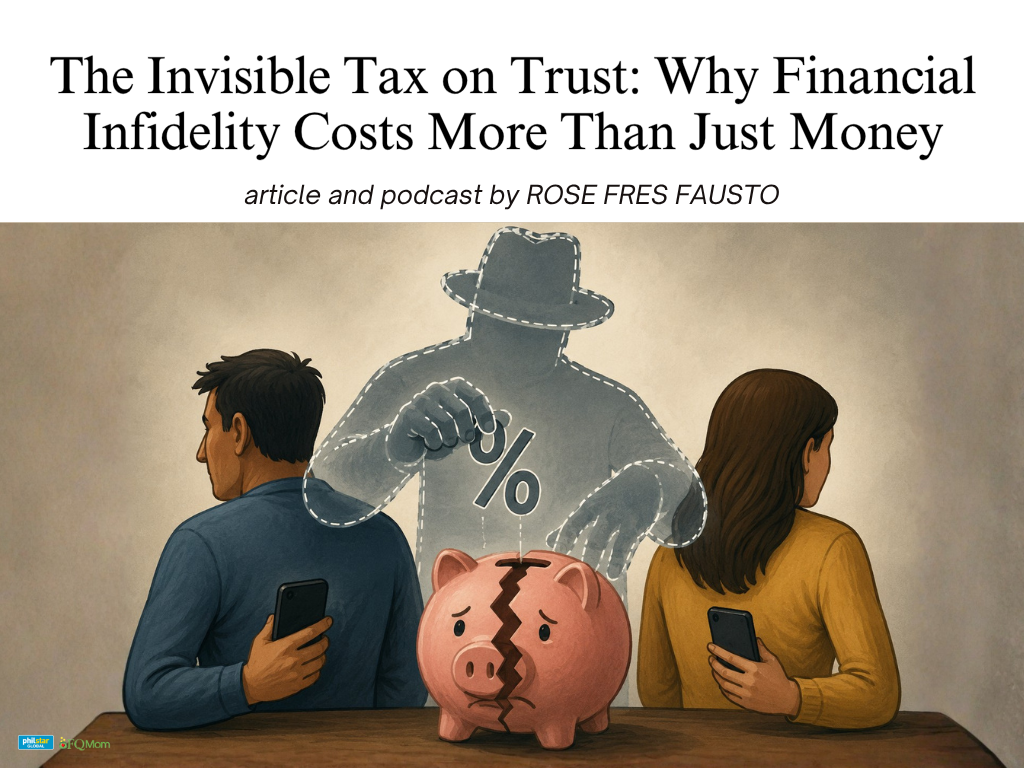
The Invisible Tax on Trust: Why Financial Infidelity Costs More Than Just Money
May 15, 2026 was the International Day of Families. It may not be as popular as the previous Sunday’s Mother’s Day but it is likewise important and should remind us of the significant value of family, the basic unit of society.
The foundation of a strong family is built on more than just love; it is built on trust. We often speak of physical and emotional infidelity as deal-breakers in a relationship. But there is also this silent, often overlooked form of betrayal that can be just as corrosive to a family’s future: Financial Infidelity.
For many of us, our stand on what constitutes physical and emotional infidelity is clear—it’s black and white, but when it comes to financial honesty, it becomes surprisingly gray.
You might take pride in being a loyal partner, yet you find yourself hiding your Shopee purchases, downplaying the true cost of your shoes, bags, gadgets, or keeping a secret stash that your spouse knows nothing about. Is this just a diskarte, or is it a symptom of a deeper issue? In our culture, especially for women, “Magtabi ka para sa sarili” is often framed as a survival tool or a form of empowerment. We hear advice like “Huwag mong ibigay lahat” as a way to protect ourselves. But we must ask: Does this protection actually serve a healthy, high-FQ partnership, or is it a sign that we don’t feel safe enough to be fully transparent?
What Constitutes Financial Infidelity?
Financial Infidelity isn’t always about a secret bank account with millions of pesos. It is the act of hiding financial information, transactions, or important money matters from the person you are supposed to be building a life with. It starts small—a secret purchase here and there—that can snowball into hidden debts, siphoned family funds, or even lied-about income.
When we hide money, we are usually not just hiding cash; we are hiding fear, a desire for power, or a lack of safety. High-FQ couples understand that true empowerment isn’t found in secrecy, but in the structural design of their money rules together.
Deepen Your Family’s Financial Trust
If you have ever felt the need to hide a purchase or felt a pang of guilt when a credit card bill arrives, it’s time for a conversation. Transparency is the “sunlight” that disinfects the hidden corners of our financial lives.
To help you navigate this complex topic, I have put together a special 3-Part Financial Infidelity Series. Over these three episodes, we will dive deep into:
Part 1: What exactly counts as Financial Infidelity?
Part 2: The 10 symptoms to look for (Are you or your partner doing these?)
Part 3: Concrete steps to avoid this dangerous form of “pagtataksil” and build a peaceful financial relationship.
You can catch the full series on my YouTube, Podcast, FB, IG, and TikTok channels. Use them to protect yourself from Financial Infidelity—the dangerous affair you may not know you’re already having!
ANNOUCEMENT
1. Building a strong family requires absolute trust, yet many couples unknowingly damage their relationships through hidden purchases and financial secrecy. Take the FQ test today to see where you stand on financial honesty and learn how to build a truly transparent, high-FQ partnership.
2. True family empowerment isn’t found in financial secrecy, but in the structural design of your money rules together. Stop letting financial infidelity quietly weaken your bond and secure a transparent, high-FQ future today with the FQ Trilogy! Grab your copy here.
This article is also published in Philstar.com
