
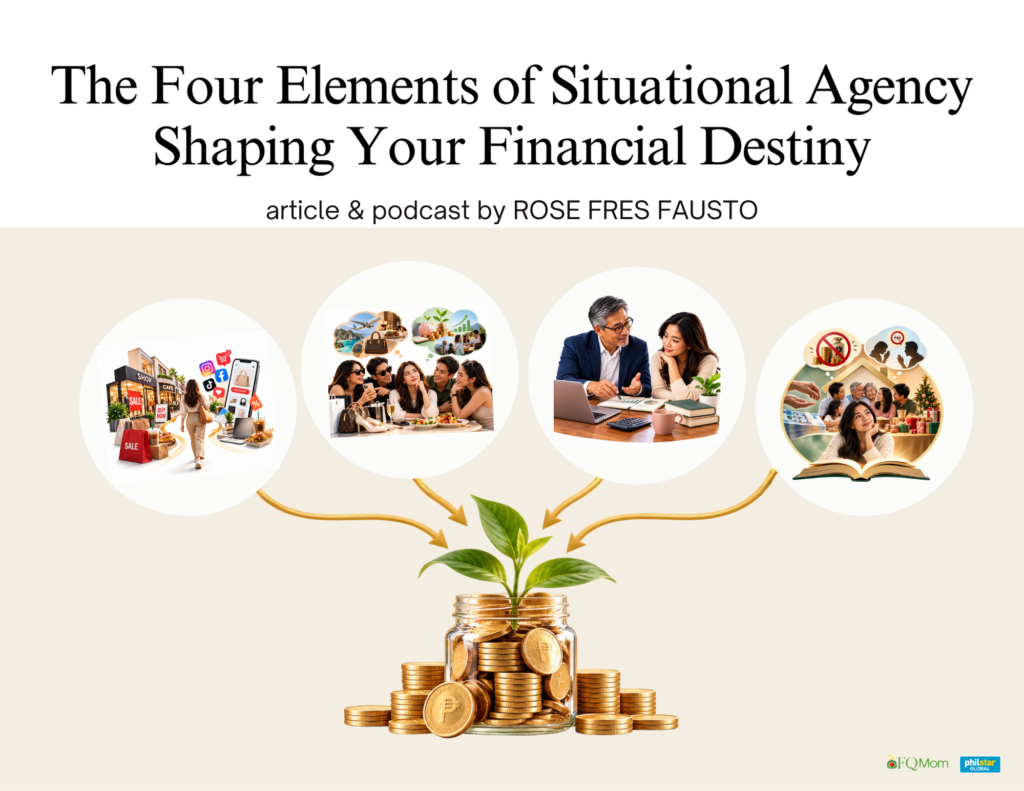
The Four Elements of Situational Agency Shaping Your Financial Destiny
Last week, I discussed with you the idea that willpower is not enough. I enjoyed reading Situated the new book of Angela Duckworth of the bestselling book Grit, because ten years after she’s now saying that relying on grit alone is not the best way to achieve our goals. We need to be “well-situated.”
She introduced the term Situational Agency, which means taking charge of our circumstances, choosing to be with people and in places that bring out our best.
Let’s now apply situational agency on our financial well-being. This is realizing that our financial decisions do not happen in a vacuum but are deeply rooted in the context of our immediate environment and the people around us. Having a high FQ is not just about having a high financial literacy score but doing the correct money behavior, and this can only be done by understanding our own behavioral biases lengthily discussed in FQ Book 2 and using the power of design to achieve your financial goals. This resonates well with the four elements of situational agency that we will discuss today. Below, we will discuss the four elements and how you can use design or your situational agency in your favor with the end goal of healthy financial well-being.
1. SPACE: The Architecture of Your Financial Choices
Your physical and digital surroundings continuously nudge your financial actions, often without your conscious awareness. On your way to school or work, do you pass by commercial establishments that entice you to spend? In your school or place of work, are there many temptations that will make you spend? Is there anything else in your physical space that will make it difficult for you to save rather than spend or borrow money?
What is your digital space like? Are your social media feeds overflowing with targeted ads and “unboxing” videos that trigger instant cravings? Is your home screen packed with e-commerce and food delivery apps that make spending just a face-ID scan away.
High FQ Agency: When you design your environment to make high-IQ and high-EQ decisions the default, you take control of your space. Design! Remove friction from good habits by automating savings and investment contributions the moment income arrives. Then add friction to impulse triggers by deleting high-temptation shopping apps or removing auto-saved credit cards from your online browsers. Stop fighting your space, it’s such a waste of that finite and fluctuating willpower—design it to work for you.
2. PEERS: Your Financial Orbit
We naturally adapt to the spending habits, lifestyle standards, and emotional energy of the people closest to us. Do your closest friends default to expensive dinners and luxury trips as their only way to catch up? Do you feel quiet pressure to match their wardrobe or gadget upgrades just to feel like you belong? Are you surrounded by people who celebrate saving and investing, or those who mock budget-consciousness with the derogatory label of kuripot?
High FQ Agency: High FQ Agency means recognizing “lifestyle creep by proxy”—the emotional urge to match the lavish upgrades or spending habits of your circle—and choosing to redesign the dynamic. You don’t have to abandon your friends, but you can lead by design: Suggest low-cost or free social activities. Normalize transparent conversations about long-term goals over material flexing. Curate a social circle that celebrates financial growth as much as immediate enjoyment.
3. MENTORS: Navigating Uncharted Waters
Who do you look up to when making big financial decisions? Are you getting advice from trusted individuals with proven track records, or are you absorbing financial “noise” from flashy social media influencers promoting quick-rich schemes? Do you have someone in your life who gently calls you out on poor money habits and encourages your long-term wealth growth?
High FQ Agency: Seeking high-FQ mentors isn’t about finding a wealthy guru to tell you what stocks to buy; it’s about aligning with advisors, guides, or trusted figures who embody the financial values you aspire to have. Design! Actively seek out mentors—whether through formal financial advisors, trusted senior colleagues, or insightful authors and podcasters. Subscribe to sensible financial content, read books of trusted personal finance experts. Proactively build relationships with people who have successfully navigated the financial stages you are entering, and ask them about their failures as much as their successes.
4. CULTURE: Unpacking Inherited Money Scripts
Culture encompasses the unwritten rules, traditions, and family expectations surrounding money that you have absorbed over a lifetime. Were you raised with the belief that “money is the root of all evil” or that talking about money is rude? Is there an implicit expectation in your family that you must serve as the primary financial safety net for everyone, even at the expense of your own retirement? Do your holiday traditions revolve around lavish gift-giving that leaves everyone financially drained?
High FQ Agency: Cultural expectations—like money being a taboo topic or the implicit pressure to act as an unscripted financial safety net—profoundly drive financial choices. High FQ Agency requires distinguishing between deep cultural respect and financial self-sabotage.
Design! Intentionally reshape your relationship with money scripts. Start by revisiting your earliest Childhood Money Memories to understand why you react to money the way you do today. Use your core personal values as your true north compass to decide which traditions to keep and which to reframe. By leveraging the other three elements—your space, peers, and mentors—you can set healthy boundaries, honor your roots, and actively cultivate a new financial culture for yourself and your family.
Just in Time for the Holidays
With the Christmas season fast approaching, you will again be subjected to an assault on our ability to practice high FQ.
It is time to use our financial agency, or as my mantra says, Design! Design! Design!—to make sure we won’t end up financially battered when January comes.
So how do we do this?
1. Space: Clean up your digital and physical environment before the shopping madness peaks. Unsubscribe from promotional holiday newsletters, mute shopping notifications, and create a physical shopping list before entering any mall or store.
2. Peers: Take the initiative in your group chats! Set gift price caps early, suggest a “Secret Santa” instead of buying gifts for everyone, or propose potluck gatherings at home over dining at overpriced holiday venues.
3. Mentors: Turn to your financial guides or accountability partners before making major year-end splurges. A quick sanity check with a mentor can keep your Christmas bonus intact for long-term investments.
4. Culture: Reframe your family’s holiday traditions around presence rather than expensive presents. Have open, loving conversations about budget boundaries, and focus on non-material ways to express love and gratitude.
By proactively designing these four elements, you don’t have to rely on depleting your willpower to survive the holidays. Take charge of your situational agency today, and gift yourself the greatest present of all: true financial peace of mind.
ANNOUNCEMENT
1. Your financial choices are shaped not just by what you know, but by your space, peers, mentors, and culture. Take the FQ Test today and discover if your financial knowledge and behavior are truly working in your favor.

2. Design your environment—and your money habits—to work in your favor. Build your financial knowledge, understand your behavior, and take charge of your choices with the FQ Trilogy—get your copies today!
This article is also published in Philstar.com
