Redesigning the Machine: Why Integrity Needs a System
Thank you for your warm and highly engaged reception of my interview with economic historian Dr. Leloy Claudio. Our discussion on how traditional government austerity measures can inadvertently choke our economic development struck a nerve. (Click link to watch.) It is a controversial take because it completely debunks the deeply ingrained Filipino belief that corruption is the absolute number one cause of our economic anemia.
Personally, I had to open my mind to accept this macro-perspective. It wasn’t easy, but I was thankful to do so. In finance, as in all other crucial aspects of life, we are far better off guarding against confirmation bias—the psychological tendency to search for, interpret, and recall information in a way that confirms our preexisting beliefs, which I write about extensively in FQ Book 2.
For someone like me who has spent years teaching personal finance, it is very ingrained in my mind that being frugal (austere) is the key to a high FQ. The first basic law of money is not to spend everything but to Pay Yourself First (i.e., to save). However, looking at the national picture forced me to recall my macroeconomics subjects. We cannot squarely apply household rules to an entire country because of fundamental structural differences.
When a single household practices austerity, the standard of living of all its members drops uniformly. But when a government slashes spending and operates on a starved budget, the effect is profoundly unequal. The standard of living of the rich remains perfectly fine, while the poor—who rely on public hospitals, public transport, and social safety nets—are hit the hardest. This distinction matters immensely in a country with a high Gini Coefficient—the economic metric used to measure income inequality, where 0 represents perfect equality and 100 represents absolute inequality. With the Philippines historically hovering at a high wealth-gap index, cutting public investments doesn’t just lower the baseline; it paralyzes the very people who need upward mobility.
In the end, it looks like a classic chicken-and-egg dilemma: Which comes first—eradicating corruption or industrializing the economy?
Because of this, both massive shifts must be simultaneously engineered. You cannot successfully do one without the other. To look at it through a household lens: you cannot build a bright future for your family by simply cutting expenses; you must also aggressively find ways to increase your income and expand your earning capacity.
Anti-corruption movements will fail if we focus entirely on the moral character of the leader while completely ignoring the broken machinery. This is the exact reason why traditional budgeting fails! If you tell people to “just be disciplined” but leave them in an environment surrounded by easy-credit temptations, predatory mobile apps, and no automated savings, they will definitely fail.
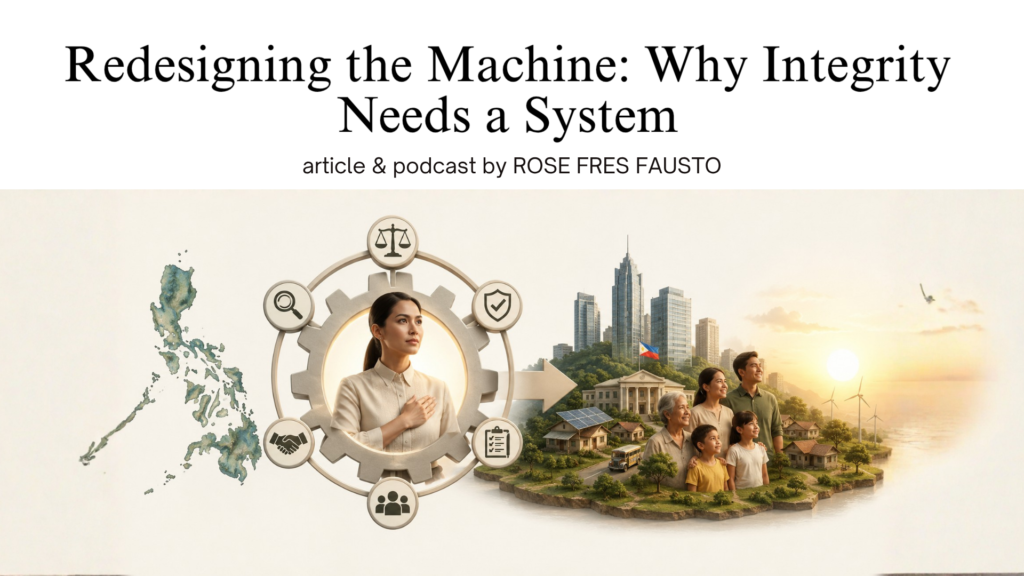
To fix the country, we have to stop waiting for flawless saints to run a broken machine. We have to redesign the machine itself so that doing the right thing becomes the easiest choice.
Fortunately, we don’t have to look far for real-world proof. Let’s examine three prominent local leaders who are currently serving their third and final terms, proving that institutionalizing systemic changes yields long-term success:
- Mayor Joy Belmonte (Quezon City): To tackle the “toll gates” of corruption, Belmonte aggressively migrated the city’s tax payments and licensing ecosystems online via automated e-services platforms. Her structural vision extends heavily into green urban sustainability, earning her global distinctions like the United Nations Environment Programme’s (UNEP) Champion of the Earth and a spot on Forbes’ International 50 Sustainability Leaders. She has systematically expanded open green spaces, doubled down on urban farming, and streamlined local government responsiveness. In fact, I recently experienced this systemic efficiency firsthand when we pitched a project for our community— to build the first Blue Zone Park in the country. Her team was mobilized and met with us in a very timely manner. While we are still awaiting the final execution and results, the swift responsiveness is a testament to a working system. Her long-term goal focuses on utilizing this green and automated infrastructure to solidify QC as the premier creative and inclusive social enterprise hub of the country.
- Mayor Vico Sotto (Pasig City): Instead of just policing employees, Vico targeted the systemic environment by completely digitizing the city’s complex bureaucracy and enforcing public, live-streamed procurement biddings. By removing the hidden backrooms where bribery thrives, Pasig saved billions. Moving forward, his long-term industrial master plan centers on transitioning Pasig from an old-school manufacturing layout into a sustainable, tech-driven innovation hub—positioning the city to attract high-value digital and creative sectors.
- Mayor Benjamin Magalong (Baguio City): Treating local governance like an engineering problem, Magalong pioneered data-driven smart city infrastructures and initiated the integration of immutable blockchain technology for government documents to eliminate document tampering. His long-term plan targets Baguio’s urban decay by shifting the local economy away from unmanaged footprint tourism into an eco-sustainable, highly professionalized knowledge and creative economy.
These leaders show us that when the systemic architecture is designed well, integrity wins.
Does this mean character no longer matters? Absolutely not. Competence without character is dangerous, but character without systemic design is simply unsustainable. In fact, these three leaders ought to have had the right moral fiber when they assumed office already—their core values were already the necessary baseline. But their true brilliance lay in realizing that good intentions alone aren’t enough to beat a bad system. We need leaders who possess the moral courage to dismantle the very systems that enrich them, and the administrative brilliance to build automated, transparent infrastructure in their place. As citizens, our job at the ballot box is to stop falling for theatrical promises of moral purity and start demanding blueprints for better systems.
We must apply this exact same philosophy to our own households. Stop relying on raw, exhausting willpower to fix your financial life. Be the “Mayor” of your own home. Build your system for the long term: establish your family goals based on your values, automate your savings, eliminate the physical friction of tracking expenses through digital tools, and focus heavily on expanding your personal productivity. (The step-by-step architecture is detailed in FQ Book 3 High FQ By Design.)
When we structurally design our personal lives to win, we stop being victims of the macro-economy—and instead, become the very engine that drives the country forward.
ANNOUNCEMENT
1. Want to know if you’re managing your money the right way?
Take the Financial Quotient (FQ) Test and discover your strengths, blind spots, and practical steps toward financial success. Your journey to a higher FQ starts here.