
Are You Guilty of Phubbing? (An Article on Cellphone Addiction and Digital Sobriety)
Are you on your phone far more than you wish you were? I am. And because of this, I have been trying to use nudges on myself to address the situation. Before I discuss the behavioral nudges, let’s talk about what’s really happening to a lot of us.
What’s the first thing that you reach out for in the morning? And the last? During the day, what are you holding almost the entire day? A lot of us may rationalize this with, “My phone is my work device.” That may be true but let me share two short stories that are very typical scenarios these days to drive the point.
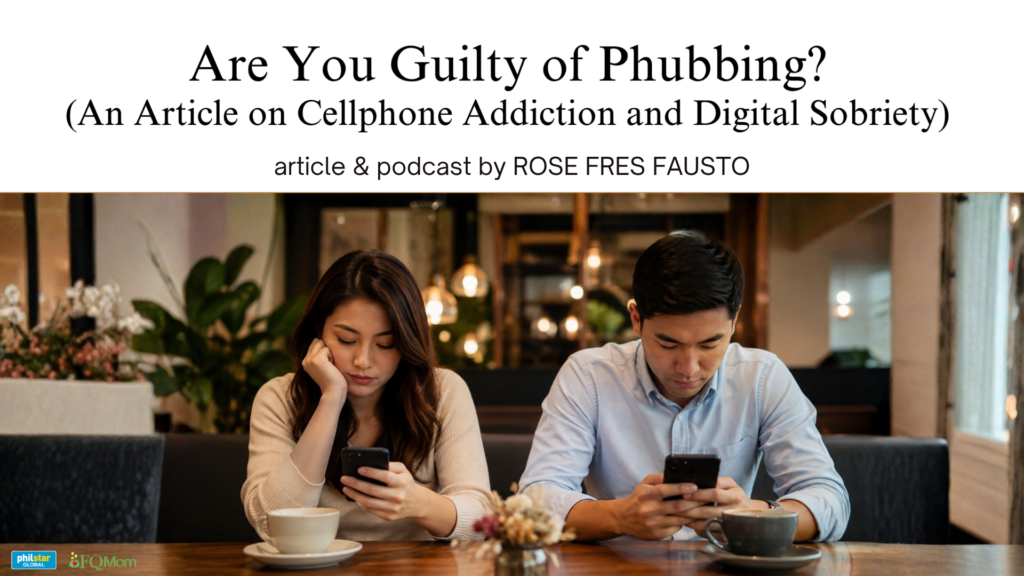
My husband and I recently had our wedding anniversary tanan in Siargao. At the resort where we stayed, they offered a special dinner package where they will arrange a candlelit set-up for two by the beach with fine cutlery and all the works for romantic dinner, for an additional fee of Php3,000. One couple availed of this package. But guess what? When I glanced at them, their faces were illuminated not by the warm glow of candlelight but by the cold blue lights of their cellphones!
We saw them again in a go-to restaurant the following day and the guy was so into his cellphone while he waited for his order and as his partner started eating. In fact, while he was eating, he would go back to his phone in between bites.
A few times in restaurants, we see families having their lunch or dinner together and what do they do? All of them, as in each family member is looking down on his phone! There’s a bit of a respite from their phones. It’s when they start eating. But soon after their last bite, or even in between bites, they are all on their phones.
Why do we act this way? It’s as if our cellphones have become our personal oxygen tanks.
Phubbing
Have you heard of the word phubbing? It is a blend of the words phone and snubbing. It refers to the rude act of ignoring the person right in front of you in favor of your phone.
In the two scenarios I narrated, it was highly unlikely that those individuals were dealing with life-and-death work emergencies. So, why do we do this, even in a paradise like Siargao or with our loved ones, our families?
If we were to be honest, we should call it what it really is: a micro-addiction. Tech platforms design their apps using variable reward schedules—the exact same behavioral mechanism built into slot machines at casinos. Every swipe, notification, or refresh gives us an unpredictable chance of receiving a dopamine hit—1.) a new like, heart, comment on a post; 2.) a direct message or group chat notification; 3.) a view count going up on a story or video; 4.) a breaking news update or trending topic; 5.) a promotional flash sale alert or stock market tick.
Over time, our brain’s tolerance grows, transforming a simple tool into a device we feel anxious without. When real-life conversation experiences a slight pause, our Emotional Emong (our impulsive, stimulus-seeking limbic system) feels withdrawal-like restlessness and craves an immediate fix. We aren’t just glancing at a screen; we are responding to a behavior compulsion that hijacks our attention.
Parallel FQ Principles Applied
Come to think of it, we can apply core FQ principles to this behavior.
- Attention Equity. Just as we wouldn’t pour our hard-earned money into low-yield, highly volatile penny stocks, we shouldn’t pour our finite attention capital into endless social media feeds. Investing that attention in our loved ones yields compounding relationship returns.
- Impulse Control. Building long-term value requires exercising our Makatwirang Mak (our rational prefrontal cortex) over our Emotional Emong to delay immediate gratification. If we cannot resist checking a notification every few minutes, we weaken the overall muscle of self-discipline.
- Capitalizing on Experiences. When we pay for a beach trip or a nice family dinner, we are deploying capital into an experience. Allowing phubbing to hijack that moment bankrupts the return on that investment before you even leave the table.
Designing Nudges to Control Cellphone Addiction
Because I know my own vulnerability to my phone, I’ve designed intentional physical nudges to protect myself. Here are some of them.
1. Good Morning Nudge Bag
I designed this primarily for myself and ended up giving this as a gift to many of my loved ones. Here’s the photo of the tote and the note that goes with it.
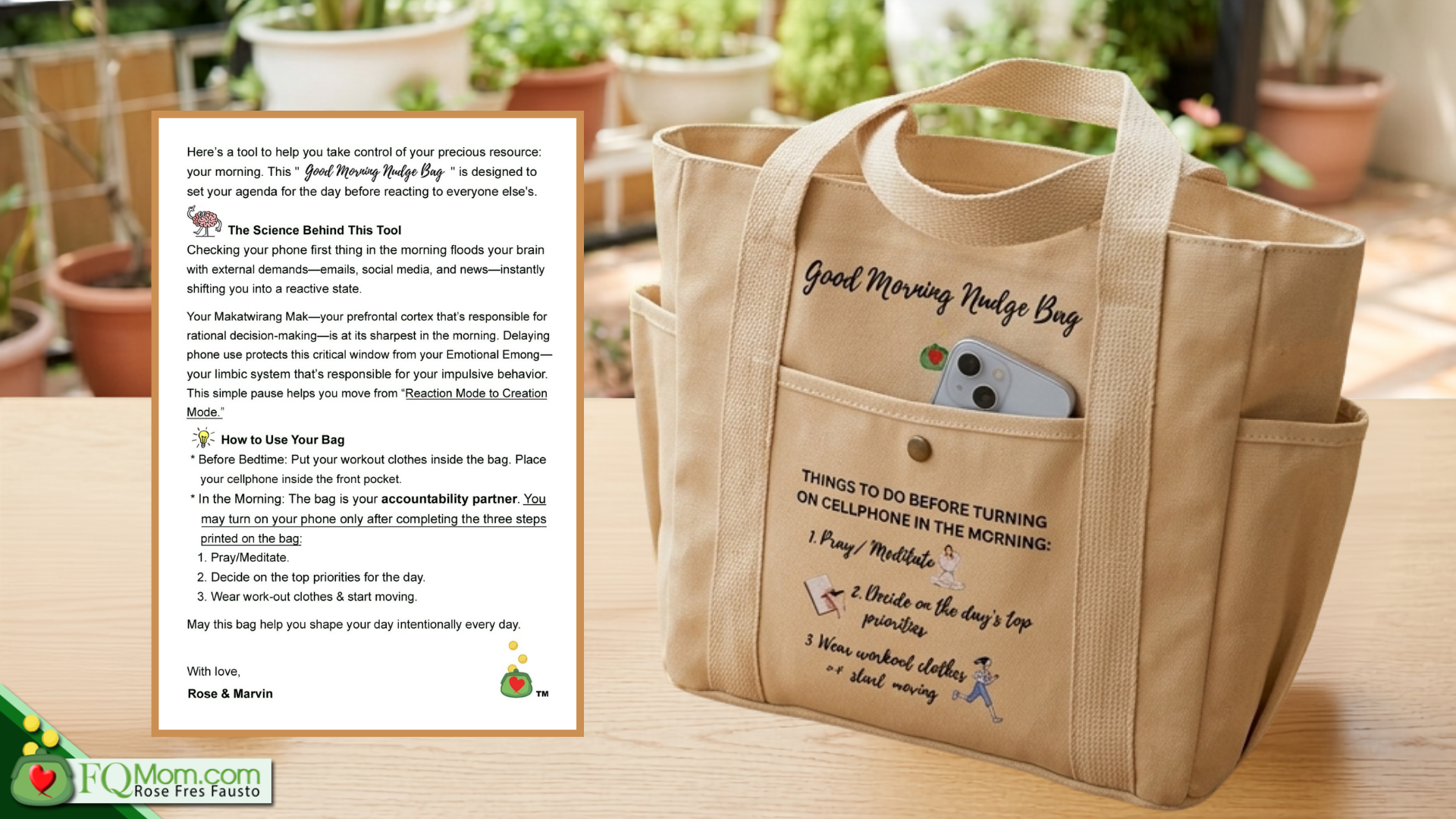
The Nudge Bag says:
Good morning ____ (name of owner)
Things to do before turning on your cellphone in the morning:
1. Pray/Meditate
2. Decide on the top priorities for the day.
3. Wear work-out clothes and start moving.
The note that goes with it says:
The Science behind this tool: Checking your phone first thing in the morning floods your brain with external demands—emails, social media, and news—instantly shifting you into reactive state. Your Makatwirang Mak is at its sharpest in the morning. Delaying phone use protects this critical window from your Emotional Emong. This simple pause helps you move from “reaction mode to creation mode.”
How to use the Bag:
Before Bedtime: Put your workout clothes inside the bag. Place your cellphone inside the front pocket.
In the morning: The bag is your accountability partner. You may turn on your phone only after completing the three steps printed on the bag.
2. The Host’s Cellphone Container
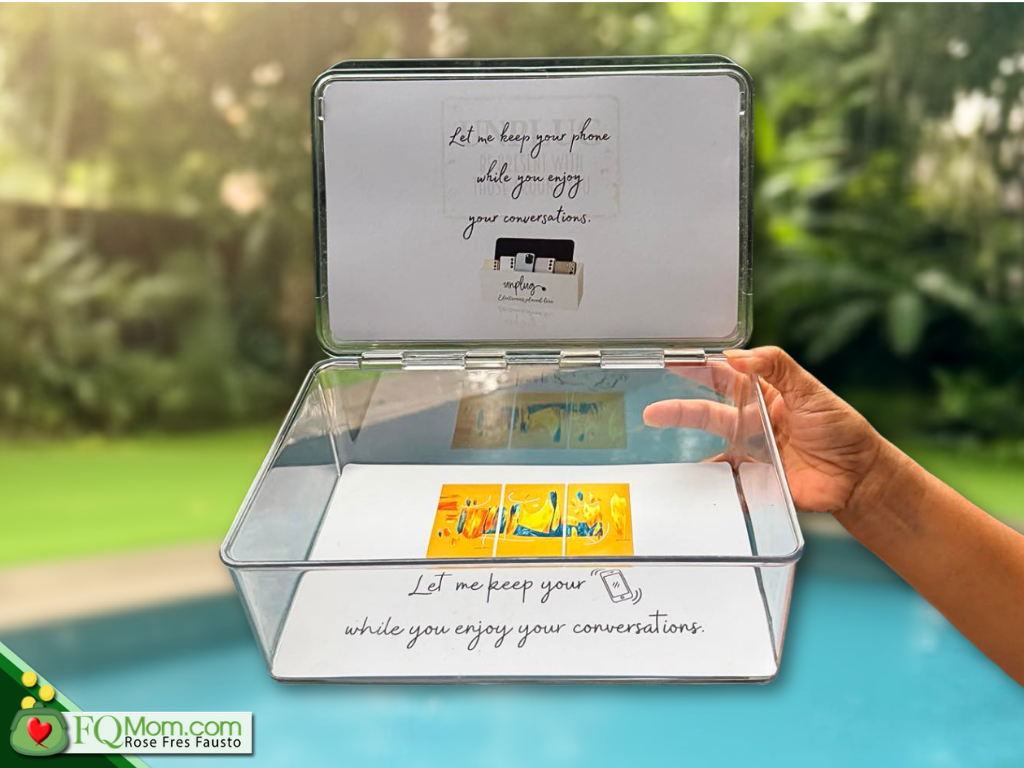
In a few parties I’ve hosted at home, I set out a designated cellphone container with a note that says: “Let me keep your phone while you enjoy your conversations.” It’s always an amusing experiment! Most of my guests are completely game and perhaps even relieved to take a break from their phones, while a few feel a bit uneasy surrendering their “oxygen tank.” But in all cases, this small physical boundary makes a huge difference in the meaningful, uninterrupted conversations that follow.
3. Zero Phones on the Dining Table
Prior to our being empty-nesters, Marvin and I have already practiced this at home with our children. When we go out for meals with them now, we sometimes remind each other of this rule. While some may be okay with the “face-down” rule, especially for those without bags, a phone sitting on the table (even face-down) signals to the people sitting with you that an interruption is waiting. So, take those phones off the table please.
4. The “Phone Stack” Challenge
I’ve read about friends and families doing this while dining out. Everyone stacks their devices out of reach. The first person to reach out for his phone before the bill arrives has to pay the bigger percentage of the bill. I haven’t tried this, but I think it will be a fun nudge to enforce presence.
5. The Excusatory Exit
If an urgent work matter arises during a meal, don’t take the call from your seat and start talking loudly. Treat it like stepping away to use the restroom: kindly excuse yourself from the table, handle the matter out of sight, and return fully present.
6. The Planned Digital Detox
Because smartphone dependency operates like an addiction, many people turn to temporary “digital detoxes”—going completely offline for a weekend, a week, or during a retreat. I successfully did this for two whole weeks when I set a strict deadline on the completion of FQ Book 2. In fact, I even wrote about it, Designing My 2-Week Hiatus To Achieve A Goal (applicable to your financial goals). While a detox is a wonderful reset to clear the brain’s chemical overload and break the dopamine loop, treat it like a crash diet: if you jump right back into your normal routine without changing your environment, you will instantly relapse. Use a digital detox as a periodic reset, but rely on daily behavioral nudges to sustain long-term digital sobriety.
7. Have an Offline Zone
This brings me to an ongoing home project. I love staying at home. This is why ever since we built our house over three decades ago, I have been very hands-on in designing, maintaining, improving, and reinventing it. It is now a spacious one-bedroom house. Why only one bedroom? Because when our sons left our nest, we decided repurpose the rooms for functional living for our Third Act. It’s a “his and hers” house but we still sleep in the same bedroom, no sleep-divorce happening yet, hahaha!
We have an al-fresco area called terraza that overlooks the garden. It used to be our go-to spot for parties and family dinners, but after our life-stage changes and renovations, I noticed we were hardly using it. So, I am currently converting it into our home’s official Offline Lounge. The plan is to populate it with board games, arts and crafts supplies, and strictly prohibit cellphones and other digital devices. For music, I am looking for a functional, but not too expensive jukebox; in the meantime, we’ll will use a turntable or an old school radio that we have at home.
The intention is for us to spend time here every day, carving out moments when we are completely unattached to our “oxygen tanks” Who knows? I might finally learn how to crochet, a skill I never learned but remember watching my mom do it effortlessly.
A Call for Self-Examination
Let’s all take an honest look in the mirror today. Are we unintentionally being rude or distant to the people sitting right beside us?
More importantly, ask yourself if you are actually doing yourself a disservice. Every time you surrender your presence to a screen during a meal, a party, a talk, or a special event, you rob yourself of deep human connection, clarity of mind, and the highest returns on your time and experiences.
The next time you sit down across someone you care for or can learn from, put your phone completely out of sight. Give the present moment of your full investment. The return is always worth it. Being fully present is the best present for the people you’re with and for yourself.
What about you? How do you manage your relationship with your cellphone? Do you have your own hacks or rules to prevent phubbing? I’d love to hear your suggested nudges!
ANNOUNCEMENT
- Are you in control of your cellphone—or is your cellphone controlling you? Take the FQ Test and discover how your financial intelligence can also shape the way you manage your attention, impulses, and everyday choices.
- Ready to build a healthier relationship with money, decisions, and the future? Get the FQ Trilogy and start transforming financial knowledge into lasting financial intelligence and better everyday choices.
This article is also published in Philstar.com
