
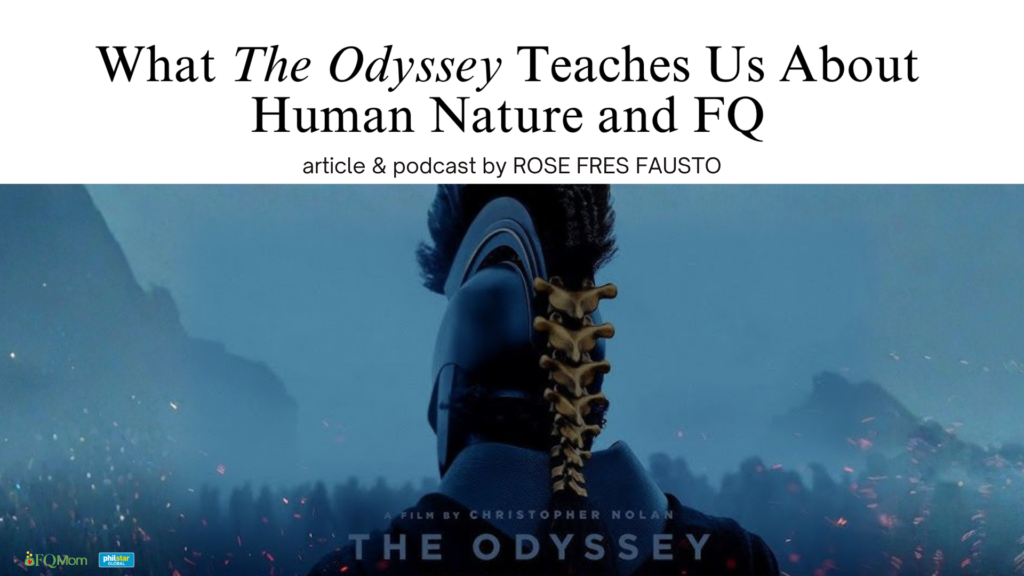
What The Odyssey Teaches Us About Human Nature and FQ
Have you seen the movie The Odyssey? If you haven’t, go see it. It’s worth your three hours. But even if you haven’t seen it yet, this piece is not a spoiler. In fact, before you go see it, it will be helpful to brush up a bit on your Homer.
After watching the movie, the Behavioral Economist in me thought, The Odyssey is actually a masterclass in Behavioral Science. Thousands of years before scientists gave official names to our cognitive biases, Homer was already warning us about the irrational, emotional things we do with our resources and life in general.
Years ago, I wrote about Odysseus being a master of commitment device when he ordered his men to tie him to the mast in order for him to hear the sirens without getting in trouble. (Click Money and Other Life Lessons from Ulysses to read the article I wrote after a devastating typhoon named after Odysseus’ Roman alias.)
Here are four timeless behavioral lessons from The Odyssey to help you make smarter financial decisions today:
1. Overconfidence Bias: Don’t Let a Win Ruin You
The Scene: After blinding the terrifying Cyclops, Odysseus (played by Matt Damon) escapes disguised under the bellies of sheep. Brilliant, right? But as his ship sails away, his ego gets the better of him. He stands on the deck and shouts his full name and home address back to the giant just to brag. Nag-yabang! Bad idea. The Cyclops prays to his father, Poseidon, who curses Odysseus with ten long years of shipwreck and ruin.
The FQ Lesson
In Behavioral Science, this is Overconfidence Bias. When we experience a big win—like a lucky stock pick or a high-return investment—we love to credit our own genius while completely ignoring luck.
That false confidence tricks us into taking bigger, foolish risks right after a victory, which is usually when we are most vulnerable to losing it all.
FQ Takeaway: Never confuse a lucky bull market with financial genius. Maintain your risk discipline, especially when you feel like you “can’t lose.”
2. The Power of Friction: Unweave Your Spending Habits
The Scene: Back in Ithaca, Queen Penelope (played by Anne Hathaway) faces immense pressure from arrogant suitors pressuring her to marry. To protect her family’s wealth and buy time, she invents a clever delaying tactic. She promises to pick a husband only after she finishes weaving a burial shroud for Odysseus’s father. But every night, she secretly unweaves her day’s work—stretching a brief delay into years of safety.
The FQ Lesson
Penelope knew the secret of Choice Architecture and Friction. When emotions run high, introducing a pause is the best way to prevent disastrous choices.
Today’s world is engineered to eliminate friction—1-click shopping, swipe-to-pay, easy-click for instant trading and borrowing, etc. make it far too easy to act on impulse. Penelope teaches us to intentionally put pauses back into our systems.
FQ Takeaway: Create pauses in major decisions, be it money or other important life matters. On money matters, use a cooling-off rule of at least 24 hours before buying non-essentials or taking a loan. When it comes to investing, pause before you panic buy or sell due to market fluctuations.
3. The Sunk Cost Fallacy: Know When to Cut Your Losses
The Scene: Christopher Nolan’s film highlights the grim reality of the 10-year Trojan War, a conflict triggered by wounded pride. Year after year, both sides poured thousands of lives and vast wealth into a bloody stalemate. Why didn’t they stop? Because they felt too much had already been sacrificed to walk away empty-handed.
The FQ Lesson
This is the classic Sunk Cost Fallacy. It’s our dangerous tendency to keep pouring time and money into a bad situation simply because of what we’ve already spent, rather than looking at future value.
We see this when investors refuse to sell a crashing asset because they want to “break even,” or when people keep throwing money into a failing business just to save face.
FQ Takeaway: Money already lost is gone. Base your financial decisions strictly on where an asset is going in the future, not what it cost you in the past.
4. Calypso’s Paradise: The Golden Handcuffs and Opportunity Cost
The Scene: Shipwrecked and alone, Odysseus washes ashore on Ogygia, the idyllic island of Calypso (played by Charlize Theron). Calypso falls in love with him and offers him everything: luxurious safety, effortless comfort, and total immortality. Yet, despite living in paradise, Odysseus spends his days sitting on the cliffs weeping as he stares at the ocean, desperate to return to Ithaca and his mortal wife, Penelope.
The FQ Lesson
This sequence illustrates The Golden Handcuffs Trap and Opportunity Cost. Calypso’s island offers absolute security and short-term luxury, but staying there requires Odysseus to surrender his life’s ultimate purpose and long-term goal.
In financial life, Calypso represents comfortable, high-paying traps that may blind us to our true long-term goals and core values. It can be in the form of a high-paying but soul-crushing job that covers your lifestyle but prevents you from pursuing what you really care about. It could also be in the form of playing it too safe by leaving all your hard-earned money in low-yield cash accounts because you feel secure, completely ignoring how inflation quietly destroys your purchasing power. Or it may even be confusing short-term luxury with true wealth—prematurely enjoying what feels good now at the expense of your long-term financial freedom.
FQ Takeaway: Don’t let comfortable salary traps or short-term security blind you to your true financial goals. Never trade your long-term independence (Ithaca) for a comfortable holding pattern (Ogygia).
The Ultimate FQ Lesson: Reaching Your Own Ithaca
The Odyssey is fundamentally a story about navigating obstacles to return home. On screen, Ithaca represents peace, security, and true freedom. In our financial lives, Ithaca is Financial Independence.
Odysseus and Penelope’s story shows us that human nature hasn’t changed in thousands of years. We still struggle with the same internal temptations: ego after a victory, impulse under pressure, holding onto bad investments out of pride, and getting trapped in comfortable status-quo situations. Every journey across the stormy sea of life comes with financial monsters and sirens. But with behavioral awareness, discipline coupled with the right structure, and a clear vision of your destination, you can navigate any financial storm and successfully make it home.
ANNOUNCEMENT
1. Ready to find out if you’re navigating your finances like a master strategist or falling for ancient psychological traps? Take the FQ Test today to discover your financial behavior style and reach your own Ithaca!
2. Master the timeless behavioral secrets behind your daily choices—and navigate your journey to true financial independence—by grabbing your copy of the FQ Trilogy today!
This article is also published in Philstar.com
