
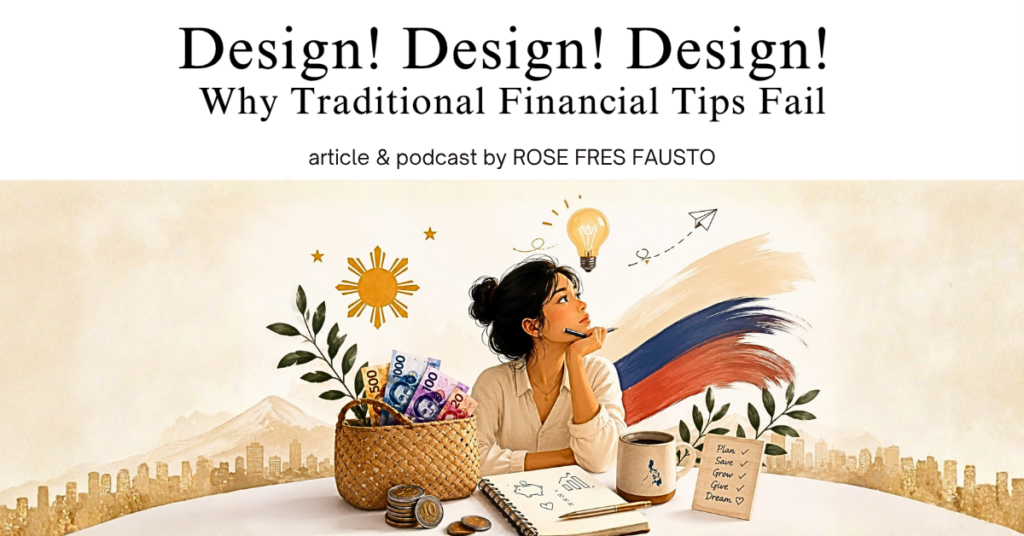
Design! Design! Design! (Why Traditional Financial Tips Fail)
The usual talks on financial literacy almost always circle back to the same familiar checklists: How to Budget, How to Build Saving Habits, Needs vs. Wants, How to Invest for Retirement, and the like.
To be completely fair, these topics are popular for a reason. They are important lessons in financial literacy, and understanding them absolutely helps. But here is my question for you, “Don’t you already know what you’re supposed to do?” Maybe a lot of you will actually answer, “Yes, I do but…” and I recall the meme of FQ Book 2, “Bakit gets ko na pero di ko magawa!”
After going through all the checklists, the finance blogs, vlogs, and so many other pieces of content, why do so many of us still struggle to actually do the right thing? Why do we download budgeting apps only to abandon them three weeks later? Why does saving feel like a painful, constant exercise in willpower that inevitably cracks when a massive online sale hits? (To learn more about this, click Ego Depletion, Your Life Choices, Kitchen Tour + Ego Depletion)
The truth is, traditional financial education treats money like a math class, hitting our rational mind, our Makatwirang Mak. It assumes that if we just learn the formulas, look at the pie charts, and track our expenses on a spreadsheet, our habits will magically transform. But handling money isn’t just an intellectual exercise. It is a deeply emotional, psychological behavioral loop. You have to acknowledge your Emotional Emong.
To make our financial solutions truly stick and stay with us for the long haul, we have to look past the surface. We have to go deep and fix the foundational layers of our money psychology. We don’t just need more information; we need a better system. We need to shift our focus from rigid rules to intentional design.
Take budgeting and sustainable saving, for example. We are told to track every single peso we spend and use pure willpower to save whatever is leftover at the end of the month. But behavioral science shows us that willpower is a finite resource. Under daily stress, it fails. Instead of relying on restriction, a sustainable approach uses Choice Architecture—which is the conscious design of your financial environment so that saving happens automatically the exact day your income arrives. By choosing to design an automated income allocation system, you remove the friction of decision-making entirely.
The same structural approach applies to the age-old battle of “Needs vs. Wants.” Traditional advice gives us a moral lecture on why we should skip our favorite daily coffee or impulse purchases. But telling yourself “no” constantly creates psychological deprivation. Instead, we need to understand our inner cognitive duality—the constant tug-of-war between the rational mind and our emotional impulses, our Makatwirang Mak and Emotional Emong. By implementing smart behavioral speedbumps, like a mandatory 24-hour cooling-off rule for online shopping carts, we interrupt impulse spending loops through environmental design rather than forced deprivation.
Even long-term planning and investing suffer from a major psychological blind spot. We are told to invest early for a retirement that is twenty or thirty years away. But behavioral experiments, including brain-scan studies, reveal that when we think about our future self decades from now, our brain perceives that person as a complete stranger! It feels like we are sacrificing our hard-earned money today to give it away to an old person we don’t even know, a stranger. (To learn more about this, click Beware of Your Filtered Self! and watch Your Future Self With Hal Hershfield)
To bridge this gap, sustainable wealth building cannot just be about complex market jargon or stock market charts. It requires us to build empathy with our future self, turning that “stranger” into a close friend we actively want to protect.
The standard financial literacy checklists aren’t wrong; they are simply incomplete. Tips and templates give you a temporary patch, but behavioral psychology gives you a permanent blueprint. This week, challenge yourself to look past the spreadsheets. Don’t just ask how to change your numbers—look at the underlying beliefs and the automatic defaults that shape your choices. True financial wellness begins when we stop fighting our human wiring and finally start using behavioral design to work for us, not against us. As I always say: Design! Design! Design!
ANNOUNCEMENT
1. Many Filipinos struggle with retirement savings, often turning to their children as a default financial backup plan. Check out this eye-opening discussion with Leloy Claudio of Proyekto Filipino, titled “Paano ang Retirement Preparation ng mga Pinoy?”and discover why we view our future selves as strangers and how automating your savings can break this cycle for good. Click here.
2. Traditional financial advice treats money like a math class, yet we continue to struggle with spreadsheets and broken willpower. Take the FQ Test and discover the behavioral design you need for permanent financial wellness.
3. If you already know what to do with money but still struggle to do it, the FQ Trilogy will help you uncover the hidden beliefs, behaviors, and psychological patterns that shape your financial decisions—so you can finally design a life of lasting financial wellness. Grab your copy here.
This article is also published in Philstar.com
