
How to avoid Isang Kahig Isang Tuka
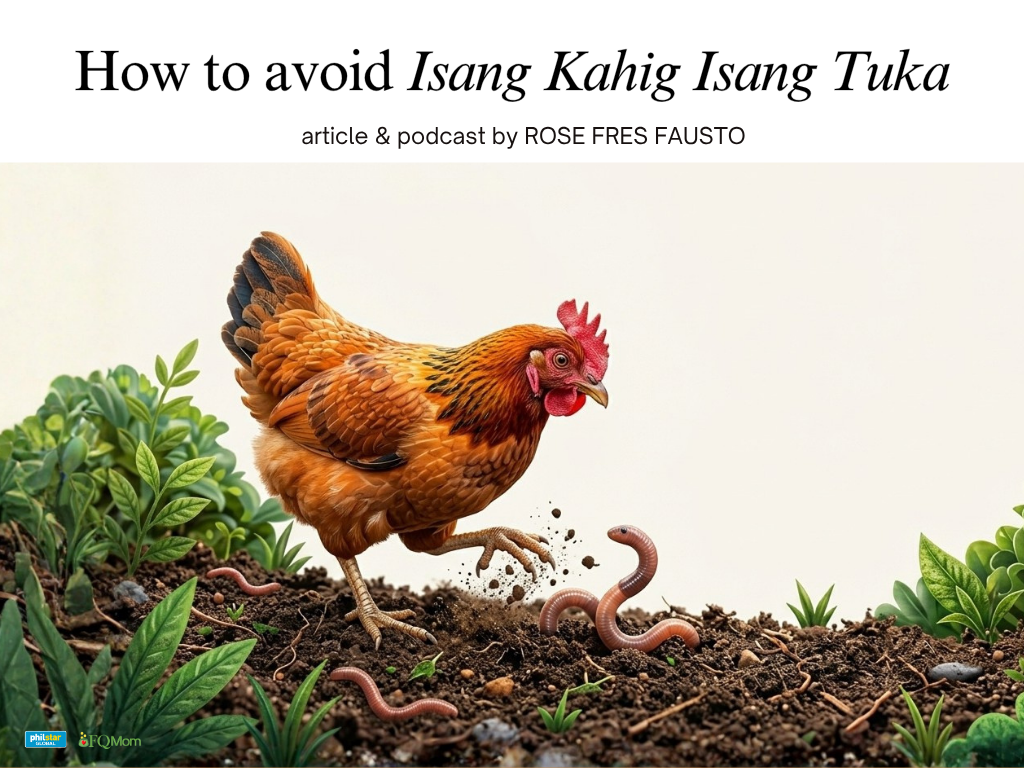
“Isang kahig, isang tuka” literally means one scratch, one peck. It is used to describe the dire financial situation of someone who barely earns enough to cover his immediate daily needs, leaving nothing saved for tomorrow.
In English, we call this “living from paycheck to paycheck.” The Tagalog version has a deeper hugot and this article does not intend to forget that a good number of our citizens are in this situation because of the many ills of our economic society. However, it is better to do something about it in your own little way rather than just to wait for our country and the people running it to put their act together.
It is also worth noting that there are a good number of high earners who also live from paycheck to paycheck. So, let’s get down to the cause of why someone ends up in this situation even if he is earning a decent amount of income.
In Behavioral Economics, we widely attribute this to Hyperbolic Discounting. It is our cognitive tendency to choose smaller, immediate rewards over larger, delayed rewards. It is also called Present Bias. In FQ Book 2, we discussed this when Emotional Emong prioritizes instant gratification, unlike Makatwirang Mak who delays gratification to reap the higher long-term reward. Another term I use to further describe this in FQ Book 3 is Money Myopia, our short-sightedness in handling our money primarily due to our inability to see our future old self and the lack of immediate feedback on our current money behavior.
Here are some ways to avoid being in this dire situation:
1. Automate Your Saving and Investing. Before you can even spend a single peso of your salary on non-essentials, a set percentage is automatically transferred directly to your savings or investment accounts. When you treat savings as non-negotiable now, your future self will be very grateful and happy.
2. Track Your Cash Flow with Intention. You cannot manage what you do not measure. Keep an eye on where your money goes every day to catch those stealthy “small” expenses that eat away at your income. Again, if you do this while you’re young, your future self will thank you, as he won’t need to do this in his old age.
3. Build a Solid Emergency Fund. Life is full of unexpected twists and turns. Aim for at least 6 months’ worth of expenses parked in a liquid earning account like money market investments so you don’t have to rely on high-interest loans when surprise costs pop up.
4. Beware of Lifestyle Creep. When your income increases, resist the urge to immediately upgrade your lifestyle. Keep your expenses stable and divert your extra earnings straight into growing your assets instead.
5. Break the “Accidental Breadwinner” Expectation. In Pinoy culture, there is a strong expectation that whoever earns the most should shoulder the financial burdens of the entire extended family. Even if you were never meant to be the breadwinner, guilt often makes you say yes to every request. Overcoming this requires learning to say a loving “no” or setting realistic limits so you do not drain your own financial future.
6. “Unsandwich” Yourself from the Sandwich Generation. Being caught between supporting aging parents and providing for growing children (or even extended relatives) puts an enormous squeeze on your finances. To break this cycle, set clear boundaries, discuss expectations openly with your family, and set an “expiry date” on dependents’ financial reliance so you can prioritize your own retirement. (To read more on the many types of Sandwich Generation, click Are you caught in the Sandwich Generation? (or are you among the lucky ones?))
7. Involve Your Family in Open Money Conversations. Managing household money should never be a one-person burden. Break the taboo of talking about money within the family—have honest discussions about shared goals, responsibility, and spending so everyone works as a unified team. To know the step-by-step method, read Chapter 7: Designing Your High FQ Family in FQ Book 3.
At the end of the day, breaking free from isang kahig, isang tuka isn’t just about how much you earn—it’s about how intentional you are with what you keep. Love your family, but remember that securing your own financial health isn’t selfish; it’s the greatest gift you can give them. Keep scratching smart, save and invest intentionally, and build a future where every hard-earned kahig builds lasting wealth. Cheers to high FQ!
ANNOUNCEMENT
- Break free from living paycheck-to-paycheck and start building lasting wealth by taking the FQ Test today to see where you stand!
This article is also published in Philstar.com
