
Discipline is Overrated: Blue Zone Choice Architecture for a High FQ
Last week, we discussed the secrets of the Blue Zones to understand why people live long healthy lives in those areas. As it turns out, it’s not because they are more disciplined than us but because of their environment.
Just as the residents of the Blue Zones don’t really spend too much time and effort trying to live to 100 but are simply nudged by their surroundings, we can design our financial environment so that building wealth becomes the path of least resistance.
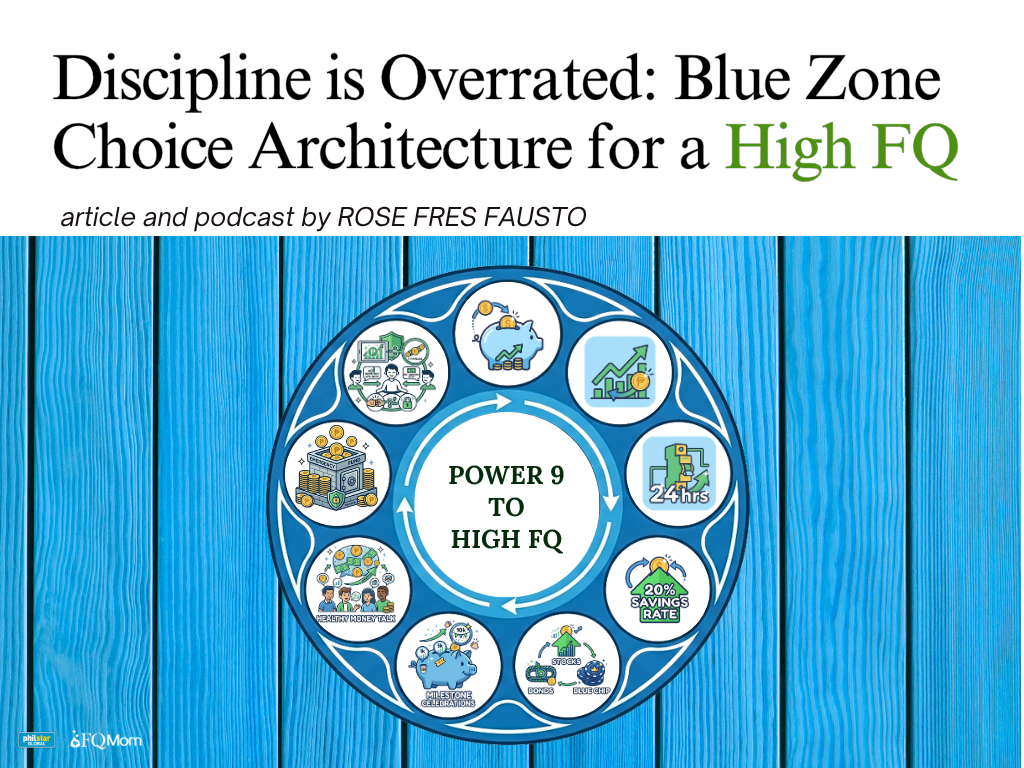
Are you ready to apply the Power 9 Principles of the Blue Zones to have a High FQ? Let’s do it!
1. Move naturally
In the Blue Zones, they are not the disciplined dudes who have to carve out regular time to hit the gym so they can observe the basic law of having a healthy body (i.e. move). They just walk regularly, automatically from one place to another.
Choice Architecture for a High FQ:
In the same way, you do not have to rely on yourself to remember and observe the first basic law of money (i.e. Pay yourself first). Just set up an automatic transfer from your payroll account to your investing account and voila! You’re now observing the law. If you automate your saving and investing now, you start moving toward wealth accumulation without having to think about it every payday.
2. Purpose
It’s useless to live a long life if you don’t see the meaning of it. The Okinawans have ikigai and the Nicoyans have plan de vida and these principles are what give them the reason to get up every morning.
Choice Architecture for a High FQ:
If you don’t know what your money is for, you will just spend it on things that don’t really matter to you. To design your ikigai or plan de vida for your high FQ, go through the exercises provided in the FQ Trilogy to know the purpose of money in your life. You’ll be asked to create your High FQ Mood/Vision Board. Furthermore, you can further name your investment accounts (e.g. Dream Home 2030, Junior’s College Fund, Retirement 2050, etc.) When your money has a name and a purpose, you are less likely to kill it with impulsive spending because every peso has a mission now.
3. Downshift
A meaningful life is bound to have stress, even in the Blue Zones. And their antidotes to prolonged stress are praying, napping, and remembering their ancestors.
Choice Architecture for a High FQ:
You may be working very hard in order to build your wealth now and that could be stressful. This is where retail therapy usually creeps in paired with a “Dasurve ko naman ito!” It has been harder to resist this temptation now because of online shopping that’s available 24/7, anytime, anywhere! Create a circuit breaker with this: When the urge to spend hits you, downshift by waiting at least 24 hours to summon your Makatwirang Mak (your rational side) and tame your Emotional Emong (your emotional side). Of course, praying and remembering your High FQ ancestors will help too. I live by my Mamang’s mantra of “Always live within your means but don’t forget to enjoy the fruits of your labor.” which happens to be Blue Zones principle number 6.
4. 80% Rule
The Okinawans stop eating when they are 80% full. It is actually a scientifically sound practice because our brain takes roughly 20 minutes to receive the chemical signals from our stomach indicating satiety. They remind themselves, “Hara hachi bu” from the original “Hara hachi-bun me ni isha irazu.” that means “A stomach at eight-parts full keeps the doctor away.”
Choice Architecture for a High FQ:
Live on 80% of what you earn. This is a very common personal finance guide for the rate of savings. This is what you can automate as your saving and investing discussed in number 1. I will go further to suggest that you increase this as you earn more so you can accelerate your wealth accumulation. Your easy-to-remember guide is this: Match your savings rate with your age until you reach 50. This may sound aggressive but it’s a sure way to achieve financial independence. By midlife, you would have accumulated enough to concentrate on the things that really matter to you.
5. Plant Slant
Plants are the cornerstone of their diet. They eat whole, real foods. They only consume meat around five times a month.
Choice Architecture for a High FQ:
Keep your portfolio “whole and real.” Stick to tried and tested assets: blue-chip stocks, real estate, low-cost index funds, bonds, and money market. Avoid the “junk food” of the financial world—trendy, speculative “get-rich-quick” schemes that lack nutritional value for your net worth.
6. Wine @5 / Unwind at the Workday’s End
They consume alcohol moderately with friends. If you’re not an alcohol drinker like myself, there’s no need to pick up the habit now. The important thing here is the unwinding, rewarding oneself, and decompressing.
Choice Architecture for a High FQ:
Don’t wait until you’re a billionaire to feel successful and celebrate. Create a budget-friendly reward system that allows you to celebrate when you hit certain savings milestones. This prevents “frugality fatigue” or “kupipot-pagod” that might derail you in this lifelong journey of having a high FQ. A sustainable FQ journey requires a little “wine” (or something else that your heart desires) along the way.
7. Belong
They are members of faith-based or tight-knit communities.
Choice Architecture for a High FQ:
Surround yourself with a community that talks openly and healthily about money. Whether it’s an investment club or a group of people with high FQ, being part of a group that values financial wellness makes you feel safe and supported. Your High FQ Journey becomes easier and more fun.
8. Loved Ones First
They put their families first, committed to a life partner, invest in their children, and care for their aging parents who live nearby.
Choice Architecture for a High FQ:
Protect those who matter most to you. If you are the breadwinner, you can apply this principle by building an emergency fund and getting the proper insurance for your dependents. This ensures that even if you aren’t there, your family’s future remains intact.
9. Right Tribe
They have social circles that support healthy behaviors like the Okinawans’ moai (five friends committed to each other for life).
Choice Architecture for a High FQ:
We are the average of the people we spend time with. Research shows that behaviors are contagious. For example, a study published in the New England Journal of Medicine found that a person’s chances of becoming obese increased by 57% if they had friends who were obese. Similarly, divorce can be socially contagious within networks. And here’s the thing, the people we hang out with are not just those we physically hang out with, but the ones we follow online. I’m not asking you to abandon your friends who are undergoing challenges but at least audit your social media accounts. Unfollow those that trigger your envy, making you spend more than you should. Surround yourself—both physically and digitally—with people who prioritize financial wellness over just “looking rich.”
The Conclusion:
The most important takeaway from the Blue Zones is this: You don’t need more willpower; you need better Choice Architecture.
If you do not actively design your environment, you are handling the blueprint of your life over to marketers, retailers, and social media algorithms who do not have your best interests at heart. It’s time to stop being a tenant in a life designed by others and start being the Choice Architect of your own future. Make good habits easy and bad habits hard. By engineering your surroundings to remember your future self, building a High FQ is inevitable rather than a struggle.
If you are ready to build your High FQ Blueprint, you can find the step-by-step mechanics detailed in the FQ Trilogy. No more waiting. No more excuses. Don’t just merely wish for a financially healthy life—design it now!
This article is also published Philstar.com
