
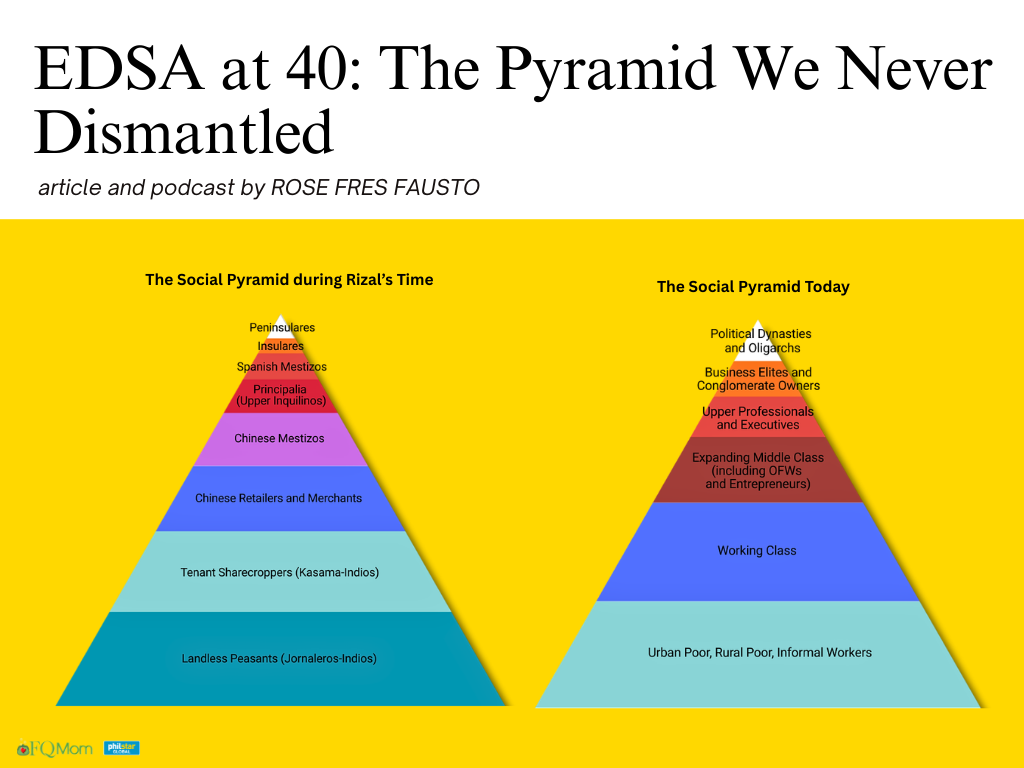
EDSA at 40: The Pyramid We Never Dismantled
During my Valentine getaway with my husband, we visited the ancestral home of Jose Rizal in Calamba, Laguna. I found myself staring at the Social Hierarchy shaped like a pyramid.
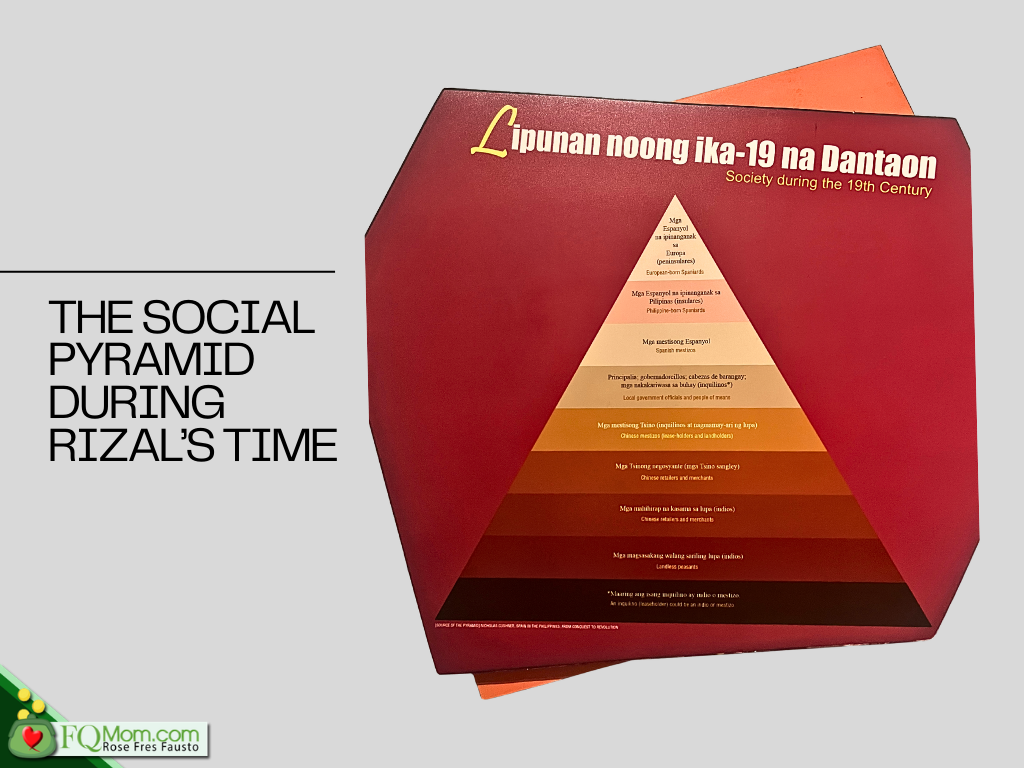
During the time of Rizal, birth and race determined one’s place in society. From top to bottom, these were the classes:
- Peninsulares – Spaniards born in Spain who held the highest positions in government and the Church
- Insulares – Full-blooded Spaniards born in the Philippines
- Spanish Mestizos – Individuals born to one Spanish parent and one native Filipino (Indio) or Chinese parent; because of their mixed heritage, they served as social and economic intermediaries
- Principalia (Upper Inquilinos) – The local noble elite and town officials who acted as primary leaseholders of large estates
- Chinese Mestizos – (Economic Inquilinos) – Wealthy mixed-race families who specialized in large-scale agricultural leasing and land management
- Chinese Retailers and Merchants – Chinese immigrants known as Sangleys who managed the majority of retail trade and commercial shops
- Tenant Sharecroppers (Kasama-Indios) – Native farmers who lived on the land and paid for their tenancy by sharing a portion of their harvest with the Inquilino
- Landless Peasants (Jornaleros-Indios) – Mobile native laborers with no permanent land rights hired for physical tasks on a seasonal wage basis
*Inquilino – a status that could be held by either an Indio or a mestizo who had enough capital to rent land from the friars.
If your family name and skin tone were “right,” your life path was charted before you even learned how to walk. If not, the odds were stacked against you—socially, economically, and politically.
A Martyr’s Death in 1896, the Revolution, and the Pyramid
Rizal was executed by firing squad in 1896 and his death acted as a catalyst transforming the fragmented uprisings into a unified revolution destroying Spain’s moral authority to rule, consequently leading to the declaration of independence on June 12, 1898.
The colonial caste system was dismantled—at least legally. Property, religion, and political authority were reshuffled. Filipinos could finally aspire beyond the station of their birth.
But while the old pyramid was demolished, hierarchy did not disappear. Land ownership remained concentrated. Access to education still favored those with means. Political leadership clustered among families with inherited advantage. The pyramid shifted from race-based to resource-based.
Another Martyr’s Death, the Peaceful Revolution in 1986, and the Pyramid
Fast forward from the 1896 execution of Rizal to 1986 People Power Revolution that was also catalyzed by gunshots—this time, the assassination of Ninoy Aquino upon his return from exile to challenge the Marcos dictatorship.
Today is the ruby anniversary of a peaceful revolution where millions gathered along EDSA in what would be globally known as the EDSA People Power Revolution. It was a breathtaking assertion of civic power without violence. Authoritarian rule fell. Democratic institutions were restored. Civil liberties returned. The press breathed freely again.
EDSA was a defining moment. It was a time of great hope.
But like the first revolution, while political power shifted, the deeper economic structure remained largely intact. The dictator fell but the pyramid endured.
Today’s Philippine Social Hierarchy no longer has eight rigid colonial layers. But it is still unmistakably a pyramid.
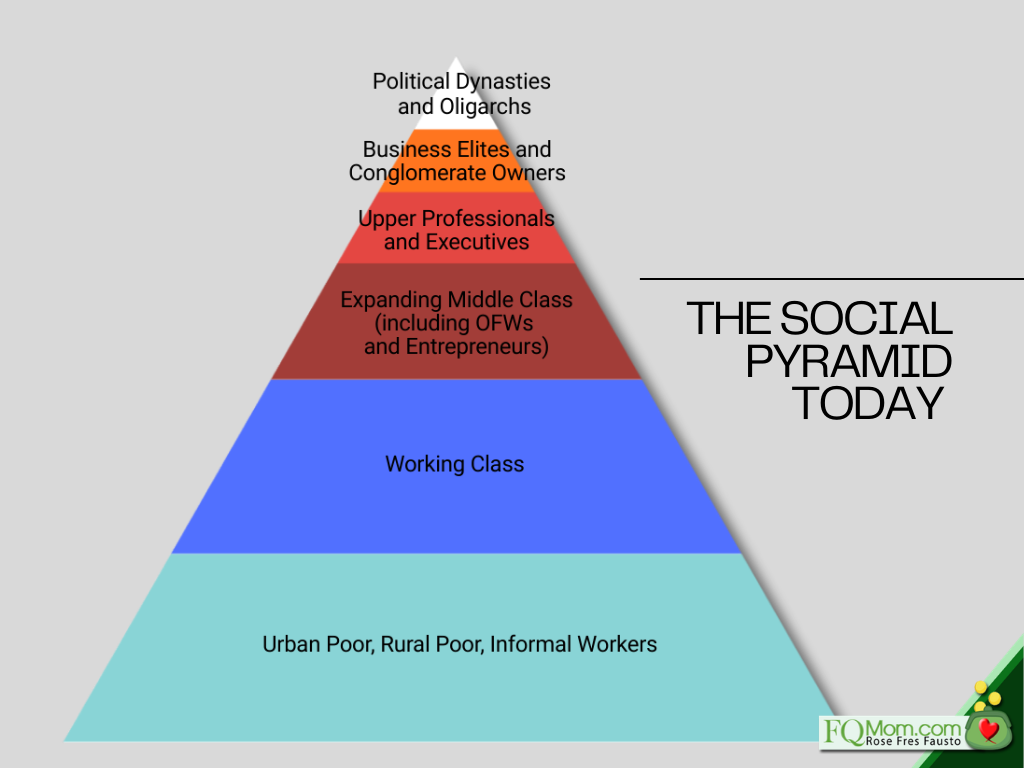
- Political Dynasties and Oligarchs
- Business Elites and Conglomerate Owners
- Upper Professionals and Executives
- Expanding Middle Class (including OFWs and Entrepreneurs)
- Working Class
- Urban Poor, Rural Poor, Informal Workers
Today, the drivers of status are no longer race and colonial decree. They are capital, networks, access to quality education, and institutional influence.
Political dynasties continue to dominate local and national offices. Large corporations control key sectors of the economy. Even education, once seen as an equalizer during the time when public education system was in better shape, has become a marker of stratification, since quality schooling often requires resources many cannot afford.
We may have a political democracy on paper but without economic democracy, our political system continues to reinforce patronage and preserve hierarchy.
Why Prosperity Remains Elusive
In my column last week, I asked why prosperity still feels elusive 40 years after People Power. (Click link to read article.) The answer lies partly in this pyramid.
Over time, we see a pattern how the pyramid has evolved.
- Wealth accumulates faster for those who already possess assets.
- Families with capital can leverage education, networks, and investment.
- Those starting at the bottom must rely primarily on labor income—often with little margin to save or invest.
In Rizal’s time, it was almost impossible to move up the ranks because birth and race pretty much dictated your place in society. Today, as we commemorate the 40th anniversary of EDSA, we know fully well that removing the dictator did not dismantle the social pyramid.
It may be impossible for us to fully dismantle this pyramid. But what we can aspire for is to give each Filipino the ability to move up the ranks more easily.
This is where Financial Intelligence Quotient (FQ) becomes critical. If IQ helps you think, and EQ helps you relate, FQ determines how effectively you navigate the economic system. And when I say FQ, I don’t just mean financial literacy. It is the ability to:
- Understand your relationship with money.
- Align financial decisions with your core values.
- Understand the basic laws of money.
- Create systems that allow wealth to grow beyond one’s lifetime.
In a pyramid-shaped economy, a high FQ is your mobility lever. Without it, families remain dependent on wages alone. With it, they can transition from earners to asset owners.
The Unfinished Revolution
Each generation has faced a different struggle. Rizal’s generation fought colonial injustice. The EDSA generation fought authoritarianism.
This generation faces a quieter, but equally urgent battle: economic inclusion.
The next revolution will not unfold in battlefields and highways. It will unfold in households and systems.
It will be about teaching children not only how to pass exams, but how to read balance sheets. Not just how to seek employment, but how to build assets. Not just how to earn, but how to save and invest. And of course, how to design family systems to make saving, investing, and other wise financial behavior the default choice.
Forty years after EDSA, perhaps the deeper question is this: Have we equipped Filipino families with the Financial Intelligence to rise?
Because revolutions can change governments but they do not automatically change economic destinies. That requires knowledge. That requires discipline. And most of all, that requires systems.
A high FQ is your economic self-defense. In a country that remains shaped like a pyramid, it is your family’s shield—protecting you from remaining at the bottom—and your ladder for climbing higher.
If EDSA gave us political voice, a high FQ gives us economic power. And that is the People Power our nation needs the most now.
Forty years later, the unfinished revolution is no longer political.
It is personal.
It is financial.
And it begins at home.
ANNOUNCEMENT
- We’ve moved from a race-based hierarchy to a resource-based one. To move up, you need more than just a salary; you need a system. Do you have the Financial Intelligence to rise above the bottom of the pyramid? Take the Financial Quotient (FQ) Test and find out your score in less than 5 minutes.
- From the pyramids of José Rizal’s time to the promise of the EDSA People Power Revolution, history shows that while governments can change, economic hierarchies often remain—unless families learn how to rise within them. Discover how the FQ Trilogy can become your family’s ladder to asset ownership, lasting security, and true economic freedom. Grab your copies here.
This article is also published in Philstar.com
